
Freelancers Create Assets
Freelancers come in all shapes and sizes. We’re creatives, marketers, technologists, financial professionals, tradespeople, and business consultants. Though diverse in many ways, we all have one thing in common. We make stuff. Blogs, logos, branding guidelines, new software platforms, balance sheets, water features, and business plans, just to name a few.
We get hired to make stuff because said stuff has value to the people and organizations that hire us. So I’m kind of underselling the fruits or our labor by calling it stuff. When something has value, it’s an asset.
Freelancers don’t just make stuff, we create assets.
That’s how we deliver value to our clients and that’s how we get paid. Freelancers turn commodities like deliverables and drafts into tangible value in the form of assets. The faster and more efficiently we can create those assets, the better. From our experience at least, there aren’t a lot of tools out there to help individuals and small teams do that.
There are plenty of software applications out there to help large organizations keep track of multiple business units, dozens of projects, and hundreds of employees. Freelancers don’t deal with that kind of complexity, but that doesn’t mean we don’t have a lot to keep track of. Clients, projects, tasks, and… assets. The stuff we make.
From our experience, project management software by definition makes the project the focal point, prioritizing management visibility and individual accountability while treating assets as byproducts. Hibiscus does the opposite. The asset is the foundation of its workflows.
Freelancers don’t typically manage large teams. They rarely ask, “What is Frank up to?” Freelancers need help keeping the asset development process moving, help Hibiscus can provide. Reminders, planning tools, a clear view of asset status. We offer a little bit of structure and a central hub for client, project, and task management, but most importantly, Hibiscus helps freelancers develop assets for their clients.
Asset development by Mandrake Q. Noisewater
Pretend for a moment you are Mandrake Q. Noisewater, ghost writer extraordinaire. Mandrake has a client called Teldar Paper and he’s been hired to write The Rembrandt Letter for them.
Mandrake’s a bit of an odd duck. He was up late last night consuming edibles and rewatching Zardoz on Tubi. When he woke up this morning, it was almost 10am and he thought his name was Kreskin. Fortunately, Mandrake has Hibiscus. After his second Red Bull, Mandrake logs in, has a look at the dashboard, sees his list of open tasks sorted by due date, and determines that he needs to get busy on The Rembrandt Letter…
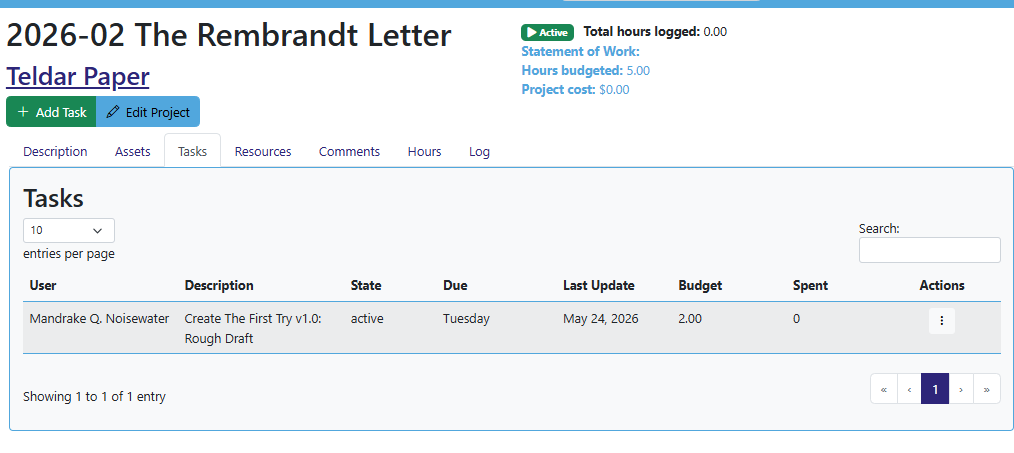
Oh, awesome! Mandrake is so relieved. The first draft of The Rembrandt Letter is not due for two days. He’s got time. Then Mandrake stops and says, “Sh*t!” He vaguely recalls working on the draft a couple nights ago when he was binging his favorite episodes of ALF and drinking wine from a box. But where is the draft? A Word doc in dropbox? Some scribblings in Amplenote? A client-shared Google doc?
Fortunately, Hibiscus knows the answer.
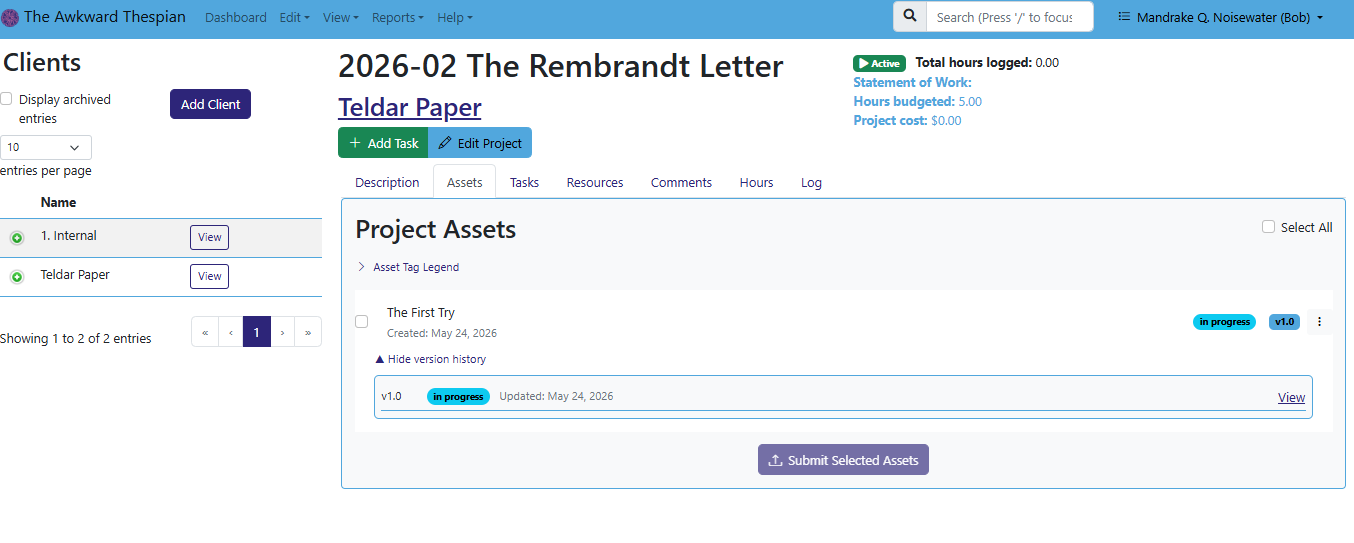
Mandrake may be disoriented and frightened, but he can read. He simply clicks on the asset tab from the project dashboard and Hibiscus shows him the draft is in process and provides a direct link to it, wherever it may be.
Mandrake resumes getting stuff done. Completing drafts, following up with clients about reviews, making revisions as requested. Mandrake is back to getting stuff done. He’s developing assets for his clients. He’s delivering value.
For a deeper dive into the asset development lifecycle, check out this tutorial on our website.